
Hardware, Hinge Lines, and Generated Worlds: How Supply, Design, and AI Are Reshaping the Device and Game Landscape
If you have been watching the tech news cycle lately, you might have noticed something. The last few weeks have delivered a pretty compact case study in how consumer hardware, game engines, and machine learning are all converging at once. Supply chains and component shortages are still dictating what actually reaches store shelves. But on the other side of that coin, designers and developers are pushing into new territory with wider foldable displays and AI tools that can generate 3D parts from a simple sentence. What you get is a technology ecosystem that looks like a hardware sprint held back by logistics, with software racing ahead to fill the gaps and create new openings.
The Steam Deck Is Back, But It Tells a Bigger Story
Take Valve’s Steam Deck, which quietly reappeared on the company’s storefront after months of scarcity. The shortage kept the handheld largely unavailable since mid February, and it highlights a problem that feels all too familiar by now. We are talking about memory and storage shortages. RAM and flash storage are the building blocks for everything from phones to gaming handhelds, and when they run short, prices climb and companies have to decide which products get priority. Valve’s return to availability, with orders shipping in three to five days, feels like a partial win. It also drives home a point about how even mature product categories are not immune to upstream constraints. Consider this. Valve’s $99 Steam Controller kept shipping through all of this because it does not rely on RAM the same way. That is a small detail, but it speaks volumes about how component availability shapes product roadmaps.
Foldables Are Getting Wider, and That Matters
While supply chains are adding uncertainty to hardware launches, the visual direction of devices is changing fast. Samsung’s upcoming Galaxy Z Fold 8 leaks point to a wider variant that might be marketed as the standard Z Fold 8, with a narrower model becoming the Z Fold 8 Ultra. That shift shows a renewed focus on aspect ratios. The wide Fold opens to a display that works better for videos and games. Hands on images reveal a frame that looks remarkably thin, even if a hinge gap hints at all the mechanical complexity hiding inside. Designers are trying to balance thin profiles, durable hinge mechanisms, and ergonomics all at once. And a wider interior screen suggests manufacturers are optimizing for content consumption and immersive mobile gaming, not just multitasking or productivity. It is a subtle change, but it could reshape how developers think about their UI layouts.
This is part of a broader trend we have been tracking. As we noted in our analysis of 2026 hardware leaks, the form factor evolution is accelerating across the board.
Apple’s iPhone 18 Pro: Small Changes, Big Ripples
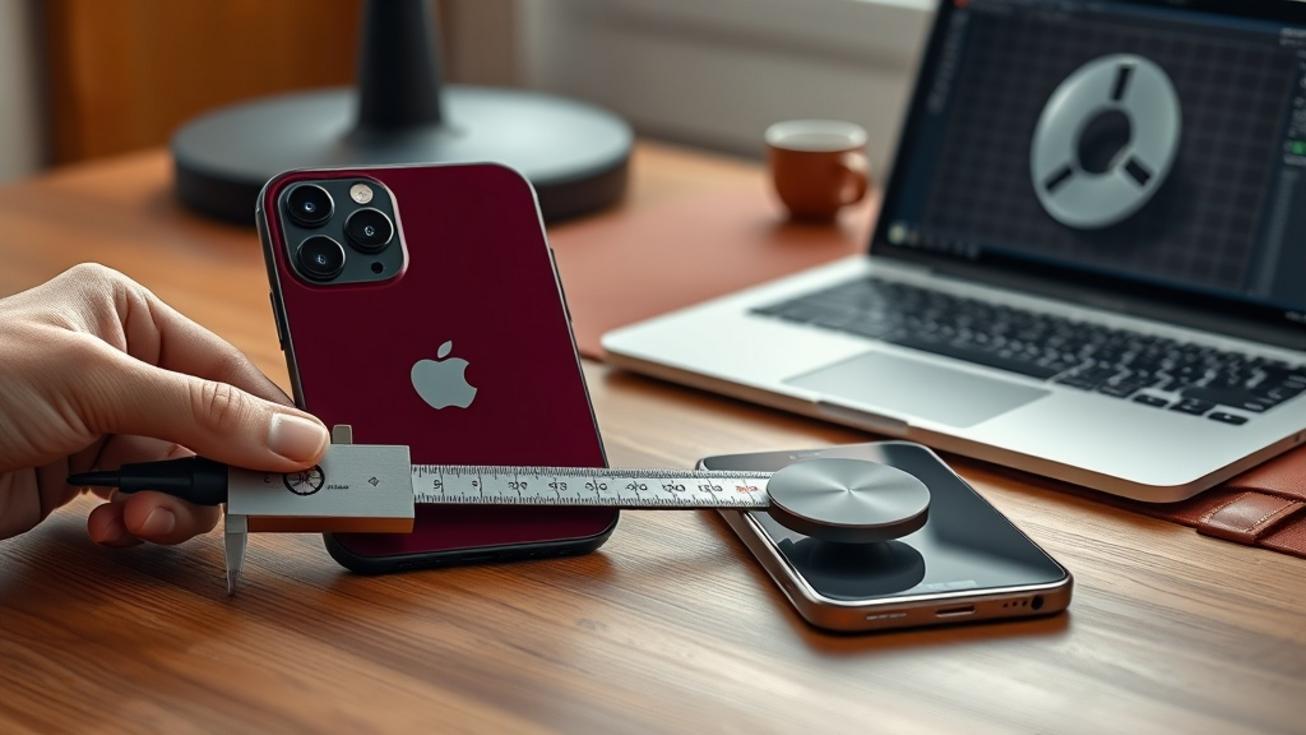
Apple’s iPhone 18 Pro leaks are telling a similar story through a different lens. Case images and a hands on video reveal new colorways, including a Dark Cherry finish that looks genuinely good. Accessory clues suggest a smaller Dynamic Island cutout and possibly thicker bodies than the prior generation. MagSafe compatible cases give away magnet ring placement and potential camera layout changes. The hint that the 18 Pro family may be thicker means new cases probably will not work with older models. These are small mechanical evolutions, but they matter. Subtle changes in thickness, cutouts, or external symmetry influence everything from accessory ecosystems to heat dissipation strategies under the hood. For developers building accessories or companion apps, these are the details that make or break compatibility.
We have been watching this space closely. Our coverage of iPhone 18 leaks alongside Computex chips and AI 3D tools explores exactly how these hardware signals connect to the broader developer landscape.
Unreal Engine 6 Raises the Bar
Design changes in phones and foldables are not happening in isolation. On the software side, Epic Games recently revealed the first Unreal Engine 6 game, and notably it is not Fortnite. Game engines provide the rendering, physics, and tooling that developers use to create worlds. Each new engine generation raises the bar for what hardware must deliver. Developers will increasingly expect higher fidelity assets, more complex simulations, and tighter integration with AI driven tooling. When engine capabilities expand, device designers and component suppliers get pushed to support those experiences. That might mean more memory, faster storage, or different thermal envelopes. The hardware boldness and software rethink we saw in April 2026 is only going to intensify.
AI Tools: The New Shortcut for 3D Creation
This is where AI tools start to change the calculation. CNET’s look at CubePart, an open vocabulary, part controllable 3D generator, hints at a future where creators can iterate on complex geometry using simple text prompts and parameter controls. Open vocabulary means the tool accepts a wide range of natural language descriptions rather than a fixed set of commands. Part controllable means designers can target specific components of a model, not just generate an entire object at random. For game developers and hardware designers, this is a big deal. Rapidly generating concept assets, iterating on hinge geometries, or producing dozens of colorway renders for a new phone could be dramatically faster. It also lowers barriers for small teams to produce assets that look professional, feeding directly into pipelines for engines like Unreal Engine 6.
Of course, there are questions worth asking. How do you validate AI generated geometry for physics and collision? What about animation rigging? The accountability conversation around AI is not limited to courtrooms and policy debates. It applies just as much to asset pipelines and game development workflows.
Connecting the Dots
Put these threads together and you start to see a clear pattern. Component shortages are constraining what hardware ships and when, nudging companies to be selective about which products they prioritize. At the same time, device form factors are evolving toward screens optimized for media and gaming, reflected in both foldable aspect ratios and subtle mechanical adjustments in flagship phones. Meanwhile, software and AI tools are accelerating creative iteration, enabling richer game worlds and faster prototyping for hardware. The late stage of product development is becoming as much about software driven content and tooling as it is about PCB layouts and chassis dimensions.
For developers and technologists, this convergence matters in practical ways. When planning a game or an app, you should anticipate wider and more varied display aspect ratios. Design UI that scales without assuming a single narrow canvas. Expect asset pipelines to increasingly accept AI generated geometry, but also plan for validation steps. Automated outputs still need human oversight for physics, collision, and animation. From an infrastructure perspective, teams should expect that engines will demand more RAM and storage, so budget accordingly for test devices and cloud rendering resources.
What Comes Next
Looking forward, the tug of war between supply and demand will likely continue. But software will keep advancing faster than hardware distribution can follow. That mismatch creates opportunities. Developers who embrace adaptable design, modular assets, and AI assisted pipelines will ship experiences that feel native on next generation devices whenever those devices arrive. Manufacturers that anticipate software trends and design for broader content ecosystems rather than incremental spec upgrades will be better positioned when supply catches up.
We are not entering a tranquil period of stability. Not even close. We are in a stage where hardware availability, daring physical design, and accelerated content creation are co-evolving. The next year will test how well the industry integrates these forces. For creators, the rules are straightforward: design for uncertainty, automate what you can, and keep human judgment where it matters most. For hardware teams, every millimeter of thickness and every gigabyte of RAM will be an explicit decision. Those decisions will shape not just devices, but the worlds that run on them.
Sources
- Valve’s Steam Deck is back in stock after months, but you won’t like it – Ars Technica
- Samsung’s wider Galaxy Z Fold 8 hardware leaks in hands-on – 9to5Google
- iPhone 18 Pro leaked video and case images – Notebookcheck
- Epic reveals first Unreal Engine 6 game – PC Gamer
- CubePart 3D Generator – CNET