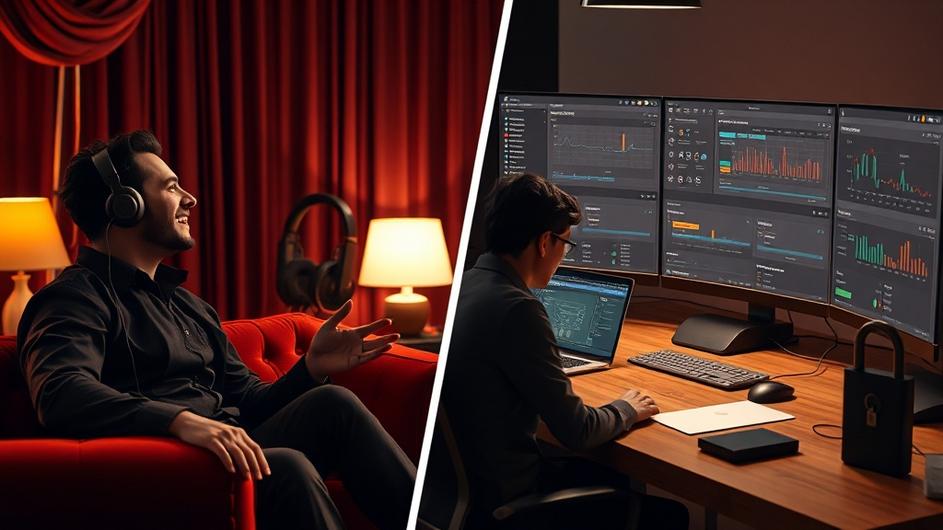

From Monumental Models to Whisper-Quiet Voices, AI Is Reshaping Both Cloud Power and Edge Privacy
This week gave us a textbook example of how artificial intelligence is evolving in two completely different directions at once. If you’re an engineer trying to decide where to run your AI workloads, or a product manager balancing raw capability against latency and security, pay attention. Because what just happened tells us a lot about where this technology is headed.
On one side, we’ve got the leaked news about Claude Mythos, Anthropic’s upcoming flagship model that the company calls its most powerful creation yet. On the other side, Mistral AI just dropped Voxtral TTS, a featherweight open-source text-to-speech engine built specifically for edge devices like smartwatches and phones.
These aren’t just random product announcements. They represent fundamentally different philosophies about what AI should be and where it should live. One pushes the boundaries of what’s possible with massive computational power. The other asks how little compute we can get away with while still delivering useful intelligence right where users need it.
The Cloud Titan: Claude Mythos and the Raw Power Play
Let’s talk about Claude Mythos first. According to that leaked internal document from Anthropic, this thing is supposed to be a “performance step change” over anything they’ve built before. They’re already running early trials with select customers, which tells you they’re pretty confident about what they’ve got.
We’re talking about a model that could handle complex reasoning tasks, summarize massive documents in seconds, and automate workflows that would normally require human intervention. That’s the promise, anyway. But here’s where it gets interesting, and maybe a little concerning.
The same leak that hypes up Mythos’s capabilities also includes a sober warning from Anthropic about cybersecurity risks. The company apparently flagged that this model could be misused to write more convincing phishing emails or bypass security controls faster than ever before. It’s a reminder that when you build a tool this powerful, you’re not just creating opportunities, you’re also expanding the attack surface.
Think about it like this: giving developers access to supercharged AI is like handing out industrial-grade power tools. They can build amazing things faster, but they can also do a lot more damage if they’re not careful, or if someone with bad intentions gets their hands on them.
For security teams, this means threat modeling needs to become a core part of the development process. You can’t just plug in a powerful model and hope for the best. You need rigorous input validation, constant monitoring for malicious outputs, and layered safety controls. It’s not just about what the AI can do, it’s about what someone might try to make it do.
This push toward ever-larger models isn’t happening in a vacuum. As we’ve seen in our coverage of AI monetization trends, there’s intense pressure on companies to demonstrate breakthrough capabilities that justify their valuations and attract enterprise customers.
The Edge Whisper: Voxtral TTS and the Privacy-First Approach
Now let’s flip the script and look at what Mistral is doing with Voxtral TTS. This isn’t about raw power, it’s about efficiency and privacy. Voxtral is optimized to run on edge hardware, meaning it processes text-to-speech locally on your device instead of sending your data to some distant cloud server.
The technical specs tell the story: 90 milliseconds from text input to first audio output. That’s fast enough for actual conversations, not just pre-recorded responses. For developers building voice interfaces for smartwatches, hearing aids, or privacy-sensitive applications, that latency matters. A lot.
What’s really significant here is the open-source nature of Voxtral. When a model is open source, developers can customize it, audit it for security flaws, and integrate it into products where regulatory requirements demand local processing. Think healthcare apps that handle patient data, financial tools that process sensitive information, or any application where users just don’t want their conversations floating around in the cloud.
This edge-focused approach solves a completely different set of problems than the cloud giants are tackling. It’s about latency, battery life, and data sovereignty. Saying a model is “lightweight” means it’s been tuned to use less memory and compute power so it can run on processors with serious constraints.
As we explored in our recent piece on edge AI infrastructure, there’s a growing recognition that not every AI task needs to happen in the cloud. Sometimes, the best place for intelligence is right where the user is.
The Hybrid Future: When Cloud Meets Edge
So where does this leave us? With two seemingly opposite approaches to AI development, both gaining momentum at the same time. But here’s the thing, they’re not really competing visions. They’re complementary pieces of a larger puzzle.
The future of AI infrastructure looks hybrid. Massive cloud models will handle the heavy lifting, tasks that need deep reasoning, multimodal understanding, or access to enormous context windows. Meanwhile, efficient edge models will manage low-latency interactions, privacy-sensitive data processing, and continuous features like voice interfaces.
Imagine a smart assistant that processes your voice commands locally on your phone for privacy, but escalates complex follow-up questions to a powerful cloud model when you give explicit permission. Or a healthcare app that analyzes medical data on-device to maintain confidentiality, but taps into cloud AI for second opinions on complex cases.
Developers are already thinking in these terms. They’re building architectures that can route requests to the right kind of intelligence based on the task at hand. It’s not an either-or choice anymore, it’s about using the right tool for each job.
This shift toward hybrid architectures is part of a broader trend we’ve been tracking. As discussed in our analysis of AI infrastructure evolution, we’re seeing a fundamental rethinking of how intelligence gets distributed across networks.

Market Dynamics and What Comes Next
There are bigger forces at play here beyond just technical considerations. Anthropic’s push with Claude Mythos keeps pressure on competitors like OpenAI and Google to keep innovating while also clarifying their safety postures. No one wants to be the company that released a powerful AI without adequate safeguards.
Meanwhile, Mistral’s commitment to open-source, edge-friendly tooling nudges the entire industry toward more decentralized deployments. It creates alternatives to the walled gardens of proprietary cloud AI services. For enterprises, this means more options and potentially more negotiating power.
Hardware vendors are paying attention too. We’re seeing more AI accelerators designed specifically for edge workloads, chips that balance performance with power efficiency. As we noted in our look at AI hardware trends, 2026 is shaping up to be the year when specialized AI silicon becomes commonplace in consumer devices.
For developers, this is both exciting and demanding. New capabilities unlock creative possibilities that were science fiction just a few years ago. But they also require serious thinking about adversarial use cases, privacy implications, performance trade-offs, and user consent.
The best approach? Build systems with layered defenses from the ground up. Log and audit model decisions so you can trace what happened if something goes wrong. And most importantly, choose the right kind of intelligence for each task, whether that’s cloud-scale power or edge-focused efficiency.
Looking Ahead: The AI Stack Bifurcates and Reconnects
What happens next? Expect the AI technology stack to split into specialized branches and then gradually reconnect in smarter ways. Cloud providers will keep offering ever-more-powerful backend models, while a flourishing ecosystem of optimized open-source models will emerge for edge deployment.
This interplay between centralized power and distributed intelligence will determine not just what AI can do, but where and how we trust it to operate. The coming months will show us how companies manage this balance, and how developers leverage both extremes to build applications that are both more capable and more responsible.
One thing’s for sure, the days of one-size-fits-all AI are ending. The future belongs to architectures that know when to think big and when to think small, when to process in the cloud and when to keep things local. As these parallel developments with Claude Mythos and Voxtral TTS show us, sometimes progress happens in two directions at once.
For a deeper dive into what these developments mean for the next wave of AI, check out our comprehensive analysis of power, privacy, and the edge computing landscape.
Sources
1) Meet Claude Mythos: Leaked Anthropic post reveals the powerful upcoming model, Mashable, March 27 2026
2) Mistral AI Releases Voxtral TTS, Lightweight Open-Source Speech Model, MLQ.ai, March 26 2026
3) The rise of edge AI: Why processing data locally is becoming a priority, The Verge, March 25 2026
4) Anthropic’s safety-first approach faces new challenges with advanced models, TechCrunch, March 24 2026
5) Open-source AI models gain traction as alternative to proprietary cloud services, Ars Technica, March 23 2026