The State of Consumer Tech at the End of 2025, From Flagship Dominance to Clearance Deals
The final weeks of 2025 have delivered a masterclass in product strategy and market dynamics. On one side, you’ve got refined flagship devices that critics and users agree represent the pinnacle of current technology. On the other, you’re seeing surprisingly steep price cuts on phones that were top-tier just months ago. Both trends tell the same compelling story about how hardware, software, and pricing now fundamentally shape our device choices.
The iPhone 17 Pro’s Vertical Integration Advantage
Apple’s iPhone 17 Pro lineup didn’t just win readers’ choice awards and dominate tech roundups by accident. The devices stand out for industry-leading battery life, camera systems that consistently deliver, bright displays, and top-tier performance that feels effortless. These aren’t just marketing claims, they reflect Apple’s tight integration of silicon, software, and display engineering. The iPhone’s enduring advantage comes from Apple controlling nearly every layer of the stack, letting them prioritize battery and camera performance in ways competitors can’t always match. It’s a strategy we’ve seen evolving in our coverage of iPhone 17’s strategic moves.
Samsung’s Foldable Breakthrough
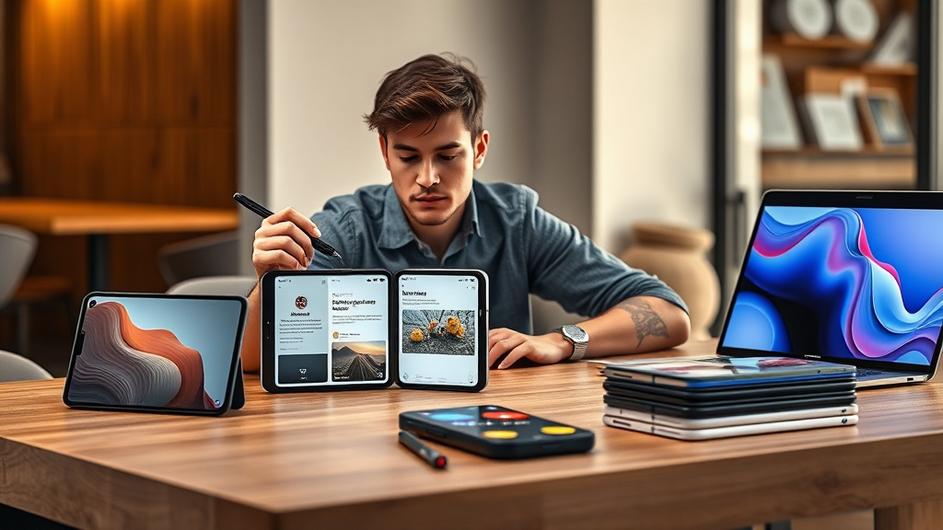
But raw excellence isn’t the only path to market impact. Samsung’s Galaxy Z Fold 7 earned praise for a different kind of breakthrough. Foldables have been promising for years, and this generation finally shrank the folded footprint enough that the phone feels familiar in everyday use, while still delivering a larger, tablet-like display when opened. It feels less like a gimmick and more like a practical evolution of form factor, one that’s finally moving from early adopter novelty to a mainstream option for productivity and media consumption. This shift represents what we’ve been tracking in our analysis of how 2025 rewrote the hardware playbook.
Software’s Growing Importance
Software matters just as much as hardware these days. Samsung spent December testing One UI 8.5 on the Galaxy S25 family, pushing beta builds for the S25, S25 Plus, and S25 Ultra as the company polishes features before a stable release expected in early 2026. For users, that means incremental improvements to daily workflows, system polish, and potentially new privacy or personalization features. These regular beta waves remind developers that Android OEMs now walk a delicate line between delivering quick enhancements and keeping the core experience stable across diverse hardware.
The Pixel 10 Clearance Phenomenon
If 2025 taught us anything about the modern smartphone market, it’s that price and update promises can be decisive. Google shipped the Pixel 10 and 10 Pro as its latest flagships this year, yet they went on clearance at year’s end with savings up to about $250, as detailed in Kotaku’s coverage. Retail markdowns brought the Pixel 10 Pro into territory that many reviewers called compelling, with the Pro model sometimes dropping to around $649 during holiday promotions. Those discounts make a powerful case for buyers who prioritize camera quality, a clean Android experience, and long software support, since Google now promises extended update windows for recent Pixels.
Why would current flagship phones be discounted so aggressively? Part of it’s cyclical inventory management, retailers clearing stock to make room for new models and seasonal deals. Another part is strategic positioning. Brands are pressing the accelerator on discounts to grow market share against slower global smartphone growth. For buyers, this moment is uniquely favorable, top-end hardware and long-term update commitments are available at midrange prices. This reflects broader smartphone market shifts we’ve been observing.
Beyond Phones: Laptops and Display Innovations
Outside phones, the laptop and gaming spaces rounded out the narrative. Apple refreshed the MacBook Pro with M5 silicon and a mini LED display, a combination that reviewers highlighted for balanced performance and excellent color and contrast. Mini LED is a backlighting architecture that packs many tiny LEDs behind the panel for better local dimming and deeper blacks, so it delivers much of the contrast people chase in OLED with fewer burn-in concerns. For hardcore gaming, high-end Windows laptops like the MSI Raider 18 HX remain the go-to, though reviews tend to point out trade-offs, like weight and battery life, that come with desktop-class components.
Display innovations continued beyond mini LED. Samsung and other manufacturers pushed QD-OLED technology, which mixes quantum dots with OLED subpixels to boost brightness and color accuracy, especially for HDR content. Whether on a phone, tablet, or TV, those differences are starting to shape purchase decisions for creators and viewers who care about color fidelity. These developments are part of the larger display technology evolution we’ve been tracking.
Broader Market Implications
Taken together, these developments underline several persistent themes. Vertical integration, as seen with Apple, still delivers advantages in performance, power efficiency, and end-to-end user experience. Industrial design milestones, like the Fold 7 shrinking the folded footprint, show that hardware still evolves in meaningful ways. And software rhythms matter, both for delivering features and for signaling platform stability, whether through Samsung’s One UI betas or Google’s long-term update promises for Pixel devices.
For developers and tech-savvy buyers, the implications are practical. App designers need to account for expanding device classes, from compact foldables with large inner canvases to laptops with mini LED panels. Software testing must extend to screens with different aspect ratios and HDR capabilities. Security and update strategies are more visible now, and they influence purchase decisions in ways that go beyond raw specs.
Finally, the pricing volatility at year-end reminds us that great hardware doesn’t always command premium prices indefinitely. The Pixel 10s moving to clearance shows how quickly the market can shift and how promotions reshape perceptions of value. That dynamic benefits conscious buyers who time purchases, and it forces manufacturers to balance product cycles, inventory, and the optics of premium positioning.
Looking Ahead to 2026
Looking ahead, expect a continued convergence of design refinement and aggressive pricing. Foldable devices will become less niche as their hardware and hinge engineering improve, while software teams race to adapt interfaces and capabilities for larger, variable screens. Display technology will continue its split between brighter, color-accurate OLED variants and high-dynamic-range mini LED panels. And on the commercial side, retailers and manufacturers will use discounts and extended update commitments as levers to differentiate in a mature market.
In short, 2025 closed with clear winners on paper, surprising bargains on the shelf, and a software landscape that’s as important as the chips and glass. For developers, buyers, and product teams, this period serves as a useful reminder, the device ecosystem is defined just as much by how well software adapts to hardware and how manufacturers manage the lifecycle of their products. The coming year will be about making those systems work together more fluidly, and that’s where real user value will emerge. This is part of the larger 2025’s gadget wave reshaping multiple tech sectors.
Sources
- Readers’ Choice Awards 2025: Your Favorite Phones, Laptops, Gaming Gear, and More, Gizmodo, Mon, 22 Dec 2025
- New One UI 8.5 beta for the Galaxy S25 lineup is out!, SamMobile, Mon, 22 Dec 2025
- Google Pixel 10 and 10 Pro Go on Clearance at All-Time Low Prices to Close Out 2025, Despite Being the Latest Smartphones, Kotaku, Fri, 26 Dec 2025
- The Android phone everyone’s talking about just got even better, Android Police, Wed, 24 Dec 2025
- Best Phones of 2025, CNET, Mon, 22 Dec 2025