
From Scale to Systems, Chips to Channels: How 2025 Rewrote the AI Playbook
If you were waiting for 2025 to crown a single, undisputed AI champion, you might be disappointed. But that’s actually the point. This year didn’t produce one dominant winner in the race for AI supremacy. Instead, it delivered something more interesting: a fundamental recalibration of priorities that’s reshaping how models get built, how companies invest, and how this technology actually reaches users.
For engineers and product leaders, 2025 felt like a clear pivot away from raw, brute-force scale toward something far more practical. It’s a shift that’s already rewriting architecture decisions, hardware strategies, and the entire market’s dynamics. The conversation has matured, and the implications are huge for developers, investors, and anyone building the next wave of tech.
The Model Evolution: Beyond Parameter Counts
Remember when everyone was obsessed with how many parameters a model had? That metric started to feel pretty hollow this year. Major releases like Gemini 3 Flash and the various members of the GPT-5 family pushed a completely different agenda. The new priorities are cost efficiency, rock-solid reliability, and something called long-context coherence.
What does that mean in plain English? Long-context coherence lets models maintain their understanding and memory across much longer documents or complex, multi-step tasks. This isn’t just about generating a clever paragraph anymore. It’s about supporting entire planning sessions, drafting iterative revisions, and acting as a true collaborator inside a workflow. When a model can remember what you discussed ten pages ago, it becomes useful for real work, not just parlor tricks.
Then there’s the ongoing battle against hallucinations, where models confidently state false information. New techniques are making real headway here, especially as models learn to reason over images, video, and structured data. These multimodal design choices naturally reduce certain types of errors, making AI outputs far more trustworthy for serious applications in science, medicine, or finance, where a human expert still has the final say. As Forbes noted in their year-end analysis, this shift from scale to substance is redefining what “state-of-the-art” really means.
From Endpoint to Engine: AI as a Workflow Component
This integration into real workflows isn’t some theoretical future. It’s happening right now. Teams are starting to expect models to act as active collaborators inside longer pipelines, interacting with tools, databases, and external APIs. That memory of prior steps, combined with the ability to call external data or execute code snippets, transforms a language model from a standalone text generator into a genuine application component.
For developers, this changes everything. You can’t just think of an AI as an API endpoint you hit with a prompt. You have to design it as part of a larger, more resilient system. That means building in proper telemetry, implementing smart retry logic, and creating explicit fallback plans when the model gets stuck. It’s a shift from prompt engineering to system engineering, a topic we’ve explored in depth when looking at how AI is rewriting software infrastructure.
The Hardware and Software Shakeup
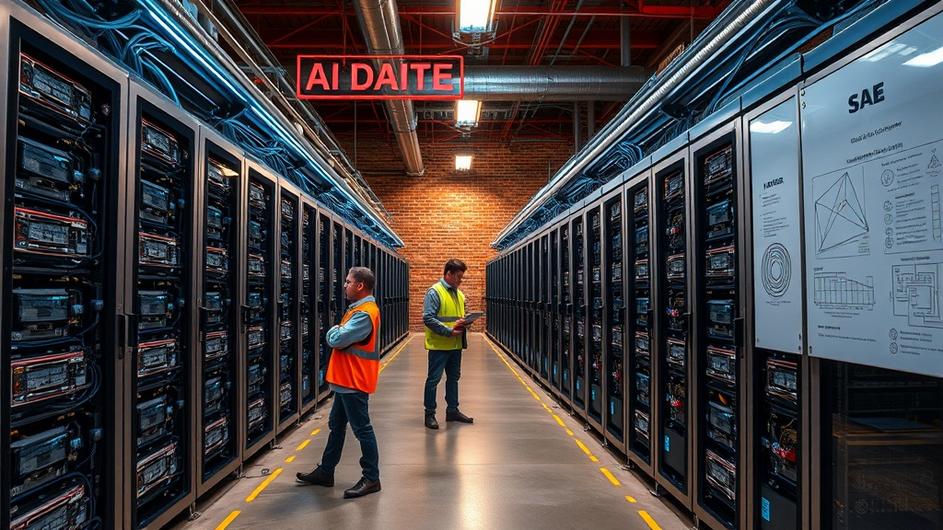
If the models themselves are getting leaner and more reliable, the industry that supplies the compute power to run them is undergoing its own dramatic evolution. The most visible market moves in 2025 clustered around two areas: inference hardware and software consolidation.
Inference hardware refers to the specialized chips optimized to run trained models efficiently. They handle the day-to-day grunt work of producing predictions at scale, and they’re becoming a massive battleground. The headline deal that captured everyone’s attention was Nvidia’s strategic agreement with chip startup Groq. This wasn’t a simple acquisition. It was a complex partnership that underlined how the entire supply side is being reshaped by alliances and deals. The market is now wrestling with a fundamental question: who actually captures the value and margins across the stack? Is it the cloud vendors, the chipmakers, or the companies that own the models?
Parallel to the hardware drama, consolidation in software and data platforms kept rolling. Rumors of mergers and acquisitions involving data giant Snowflake pointed to an industry-wide desire for unified data and model pipelines. Meanwhile, index inclusion and market momentum gave companies like UiPath serious capital tailwinds. These aren’t just financial maneuvers. They’re pragmatic responses from an industry that desperately needs predictable, scalable plumbing to deliver AI features to real end users. It’s part of a broader trend we’ve seen in the new rules of AI deployment.

The New Constraints: Distribution and Regulation
Perhaps the most sobering lesson of 2025 was that brilliant models and powerful chips mean nothing if you can’t actually get them to users. Distribution and regulation emerged as serious, non-negotiable constraints.
Platform-level clashes, like the very public debate over AI features in Meta’s WhatsApp, highlighted a brutal truth. Regulatory pressure and platform policy can determine which models reach billions of people overnight. The channels through which AI is distributed are now just as important as the technology itself. If national regulators or major platform owners decide to restrict access, they don’t just change a feature rollout. They reshape entire markets and redirect where innovation happens next.
This creates a new layer of complexity for builders. You’re not just competing on model performance or cost. You’re navigating a minefield of compliance requirements, app store policies, and regional data laws. It forces a more mature, strategic approach to product development from day one.
The Orchestration Era: What Comes Next?
So, what does all this add up to? We’re looking at a completely new competitive landscape. Smaller, specialized models that are cheaper and more reliable will sit closer to users, embedded directly inside applications. Hardware and platform deals will determine who can deliver those models at global scale while still capturing enough margin to fund the next round of research. Regulation and distribution will act as gatekeepers, deciding which experiences are even allowed to flourish.
For developers and product teams, this means designing with these constraints in mind from the very beginning. It means instrumenting systems for safety and verification, not just performance. It means choosing integration points and partners that can survive the next policy shift or platform update.
Looking ahead, the next phase will be all about orchestration. The teams that win won’t necessarily be the ones with the biggest model. They’ll be the ones who can best stitch together compact, efficient models, cost-effective inference hardware, robust data platforms, and compliant distribution channels. This is the essence of the shift we’re seeing toward agentic AI and smarter system design.
The work becomes less about building a monolithic intelligence and more about constructing the most dependable, maintainable, and adaptable system. That might sound less glamorous than chasing trillion-parameter benchmarks, but it leads to better, more reliable outcomes for actual users. It also creates clearer, more sustainable product opportunities for companies that learn to trade raw scale for system-wide reliability and resilience.
As we look toward 2026, the questions are changing. It’s no longer “who has the biggest model?” but “who has built the most intelligent, resilient, and compliant system?” The answers will define the next chapter of AI, and they’re being written right now in boardrooms, developer forums, and regulatory hearings around the world. For a deeper look at the forces shaping this future, check out our analysis of what to watch in AI for the coming year.